Linux Basic
4GB RAM, 2 vCPUs, 80GB storage, 4TB Transfer. Run WordPress, Node.js apps, or databases with room to grow.
About
The step up when one site becomes several: double the memory of Starter with the same full-root foundation.
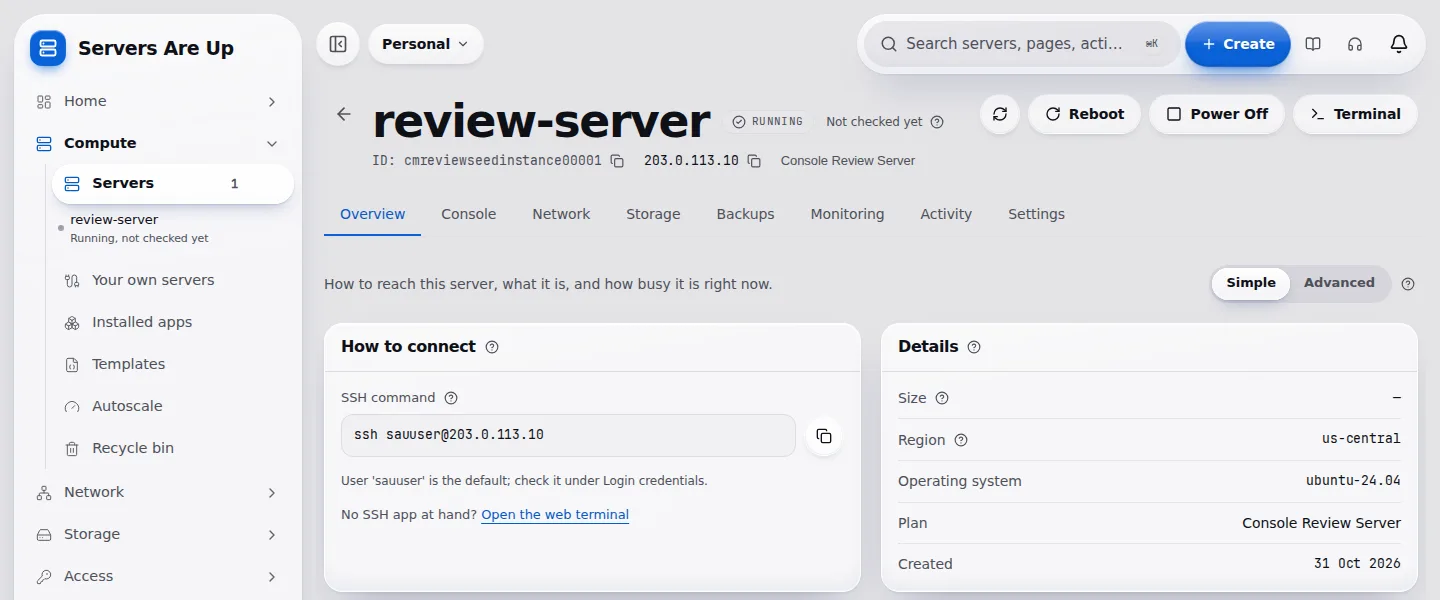
Comfortable for a Docker Compose stack of three or four services, a small e-commerce site, or a staging clone of production. Export critical guest data before experiments. Open a terminal in your browser from the dashboard, or connect over SSH with your own client.
What people run on it
Compose stack
App + Postgres + Redis + proxy on one box, managed with a single compose file.
Small business site
WordPress or Ghost with enough headroom that a traffic spike doesn’t take you down.
Staging environment
A production-shaped clone for testing migrations and deploys before they matter.
Why run it here
Opens as a terminal or desktop in your browser
Open a Linux root shell over SSH or a Windows Server desktop over RDP right inside the Datacenter Console, with two-way clipboard and pop-out windows.
Closed to the internet until you open a port
Inbound public ports stay closed until you publish an entry point or port forward and optionally restrict it to your own IP ranges.
Sized a la carte at checkout or later
Pick a standard plan or dial exact vCPU, memory and storage in checkout, priced from the base plan plus per-unit add-ons.
Driven by the AI you already use
Connect Claude Code, Codex or any MCP client to /api/mcp/v1 with a scoped token to run commands, take snapshots and manage ports.
What it looks like

Choose an Image
What's included
- Closed to the internet until you open itNothing on the internet reaches your server until you turn its public access on from its page; the console in your browser works either way.
- SSH accessTurn on public SSH from your server’s page, then connect with an SSH client.
- Terminal in your browserOpen it from the dashboard, with the clipboard in the toolbar and nothing to install.
- Full root access
- Persistent storage
- Transfer per plan specsGenerous transfer included in the price, up to your plan’s pool.
- Automated provisioningBuilt and started for you as soon as you pay.
- SLA with service creditsOur SLA gives service credits when qualifying downtime passes one hour in a month. We do not publish an uptime percentage.
Costs extra
- Dedicated public IPv4$5/mo each — add a direct public endpoint when forwarded ports are not enough.
Features
Full root access
Complete administrative control over your virtual machine
Plan-defined resources
Each plan publishes its vCPU and RAM allocation; provider compute remains shared unless a written custom agreement says otherwise
Tested Linux images
Choose from the Linux images we have tested on this plan
Snapshots & data-volume backups
Take and restore system-disk snapshots from the server page, or attach a daily data-volume backup offer
SSH key authentication
Secure access with your own SSH keys—password-free login
Frequently Asked Questions
- How is Linux Basic billed and set up?
- Linux Basic starts at $10.00/month with published resource allocations and no hidden setup fees. Once checkout completes, the provisioning worker builds and verifies the service automatically with no manual approval step.
- How do I access Linux Basic and are inbound ports open by default?
- Inbound public ports start closed to the internet until you open them from your server page. You get full root access within the Acceptable Use Policy via the browser SSH terminal in the Datacenter Console right away, or over native SSH with your SSH keys once you turn on public SSH.
- How do snapshots, backups, and AI automation work with Linux Basic?
- You can take and restore system-disk snapshots from your server page, stream encrypted tar archives to your own S3-compatible or Azure-backed Cloud Storage (/cloud-storage), or purchase a daily Cinder data-volume backup offer. You can also manage Linux Basic from Claude Code, Cursor, or Codex via /api/mcp/v1.
- Can I configure custom vCPU, RAM, and storage sizes on Linux Basic?
- Yes. You can customize Linux Basic to any whole-number configuration between 1 and 96 vCPU, 1 and 512 GB ECC RAM, and 120 to 2,048 GB storage before checkout—and upgrade in place later to larger Linux plans without losing your data volume.
- How does Linux Basic integrate with Managed Cloud Storage and Cloud Databases?
- Every Servers Are Up account includes a 5 GiB free developer tier of Managed Cloud Storage hosted via Microsoft Azure (/cloud-storage, scaling from 250 GiB at $9/mo to 25 TiB at $399/mo with double AES-256-GCM + Azure SSE encryption and WORM locks) plus 100,000 free monthly Request Units on SAU Multi-Model Cloud Database (/cloud).
- What happens if I cancel Linux Basic or want to test network routes first?
- You can test round-trip network routes from your ISP before buying using our public speedtest (/speedtest) and 22 free browser network tools (/tools). When you cancel an active subscription from your dashboard, there are no early-termination penalties.
Order Summary
Size this server
Up to 96 vCPU, 512 GB memory and 2048 GB storage. Priced as the cheapest plan plus add-ons that covers it.
Deploy multiple instances together
No setup fees · Cancel anytime · Use code WELCOME20 for 20% off your first order · Refund policy
Embed “Deploy on Servers Are Up” README Badge
Share Linux Basic in your GitHub README or docs. Readers get 20% off their first invoice with WELCOME20.
[](https://serversareup.com/products/linux-basic?promo=WELCOME20)Architecture & Buyer Guide: Linux Basic
$10/mo ($2.50/GB RAM)How Linux Basic compares on $/GB RAM, root access, and custom KVM sizing
Linux Basic provisions an isolated KVM Linux virtual machine (2 vCPU, 4 GB ECC RAM, 80GB storage) at $10/mo ($2.50/GB RAM vs $6.00/GB on legacy cloud droplets) with full root SSH access within our Acceptable Use Policy, default-closed inbound firewall ports, browser SSH console, 69 included 1-click open-source app installers in the console Apps tab, and custom sizing from 1–96 vCPU, 1–512 GB RAM, and up to 2048 GB storage.
?size=<vcpu>vcpu-<ram>gb-<storage>gb) to dial in exact CPU, memory, and storage before checkout.| Evaluation Dimension | Linux Basic (Servers Are Up) | Legacy Hyperscaler / Droplet |
|---|